Veltron Veltron

Top 10 Data Center AI Server Manufacturers Worldwide

Time:2026-09-19 Author:Madeline
0%

Artificial intelligence is reshaping the modern data center, but performance depends on more than installing powerful GPUs. A capable data center ai server manufacturer must combine accelerated computing, high-speed networking, efficient cooling, reliable firmware, and responsive technical support. Jensen Huang, NVIDIA’s founder and CEO, has described generative AI as “a new computing platform.” That shift explains why server design now affects business strategy, energy planning, and long-term competitiveness.

This article examines the top 10 data center AI server manufacturers worldwide. The comparison considers GPU and accelerator compatibility, rack-scale integration, liquid-cooling readiness, memory capacity, deployment flexibility, and global service coverage. It also considers practical details, such as how a server behaves under sustained training workloads, not only its peak benchmark score. A crowded rack can produce intense heat. Poor airflow can quietly reduce efficiency.

The ranking should not be treated as permanent. Technology changes quickly. Some manufacturers excel at customized hyperscale systems, while others serve enterprises seeking validated platforms and simpler maintenance. Pricing also varies by region, configuration, supply availability, and support terms. That makes direct comparisons imperfect.

Still, useful patterns appear. Leading vendors increasingly provide complete AI infrastructure rather than isolated servers. Their platforms may include GPUs, CPUs, NVMe storage, high-speed fabrics, orchestration tools, and remote management. Buyers should examine warranty conditions, power requirements, upgrade paths, and deployment expertise before choosing a supplier. The strongest data center ai server manufacturer is not always the one with the fastest specification sheet. Reliability matters. So does honest evaluation.
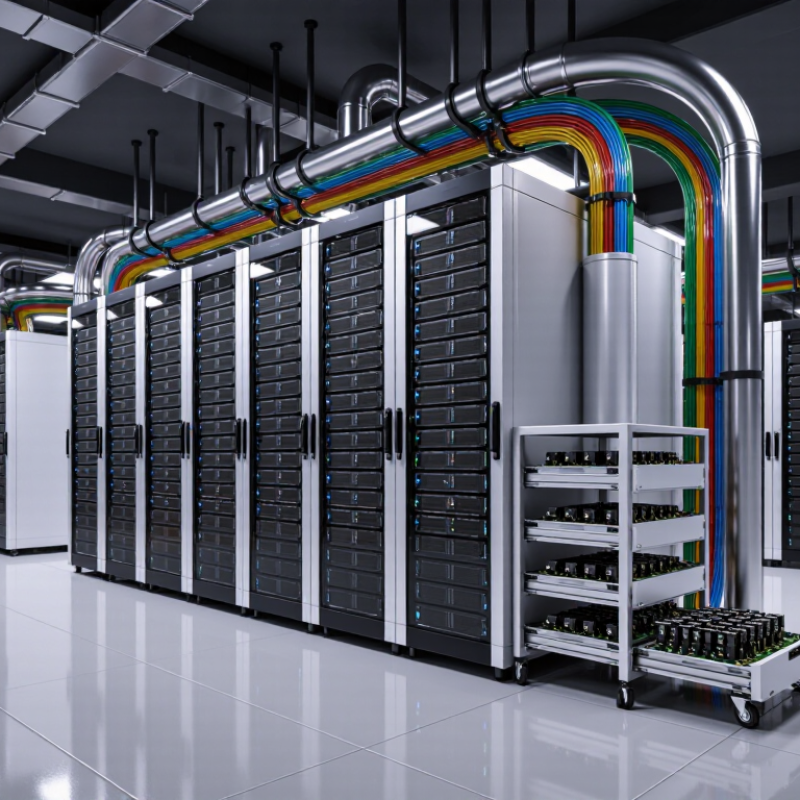
Top 10 Data Center AI Server Manufacturers Worldwide

Market Scope and Criteria for Ranking AI Server Manufacturers

The market scope covers manufacturers that design, assemble, or integrate AI servers for commercial and institutional data centers. It includes systems built for model training, inference, high-performance computing, and large-scale analytics. Custom integrators qualify when they control meaningful hardware or system engineering. Resellers alone do not.

The ranking evaluates more than processor speed. Technical scoring considers accelerator density, memory bandwidth, cooling design, networking options, uptime records, and support for common deployment environments. Operational criteria include manufacturing capacity, delivery consistency, spare-parts access, warranty handling, and regional service coverage. Energy efficiency matters too, because a dense rack can increase power and cooling costs quickly. Security practices, supply-chain transparency, and documented compliance also influence the assessment.

Evidence comes from public technical documents, audited disclosures, customer deployment records, independent testing, and interviews with data-center professionals. Performance claims receive greater weight when they can be reproduced outside controlled demonstrations. However, public information is uneven. Some manufacturers report detailed failure rates, while others provide only polished performance figures. That imbalance can affect the result. A strong ranking should therefore separate verified evidence from informed judgment and review the data regularly as architectures, regulations, and production capacity change. Market leadership is not permanent. Availability may change within one quarter.

Top 10 Data Center AI Server Manufacturers Worldwide

Market Scope and Criteria for Ranking AI Server Manufacturers

This framework shows the relative weighting of the main criteria used to evaluate global data-center AI server manufacturers. The criteria reflect measurable industry requirements, including accelerator scalability, system performance, networking, reliability, energy efficiency, supply-chain capability, software integration, and lifecycle support. The percentages represent the ranking methodology rather than company-specific results.

Global Landscape of Data Center AI Server Production

The global data center AI server market is shaped by specialized manufacturers across North America, East Asia, and Europe. Leading producers combine GPU integration, high-speed networking, advanced power systems, and rack-level testing. Production often begins with component sourcing in several countries, then moves to regional assembly centers. This structure improves flexibility, but it also exposes manufacturers to shipping delays, component shortages, and changing energy requirements.

In modern facilities, an AI server rack can consume far more power than a conventional enterprise rack. Manufacturers now test liquid cooling, high-density cabling, and automated thermal monitoring before delivery. Experienced operators also examine firmware stability, workload performance, repair access, and long-term service capacity. No ranking stays permanent. A strong producer today may struggle tomorrow if its supply chain lacks resilience or its cooling design proves difficult to maintain. That risk deserves more attention.

Tips: Compare complete production capabilities, not only processor performance. Check factory testing records, delivery history, cooling compatibility, and local technical support. Ask for measurable results under sustained workloads. Marketing claims can look impressive, yet real performance often depends on airflow, software tuning, and maintenance discipline.

Top Ten AI Server Manufacturers and Their Core Strengths

Top 10 Data Center AI Server Manufacturers Worldwide

The global AI server market includes ten major manufacturer profiles, each with a distinct core strength. One excels in accelerator-heavy systems for model training. Another focuses on custom silicon and efficient inference. A third builds dense rack servers that fit thousands of processors into limited floor space. These systems can draw more than 30 kilowatts per rack, so power planning matters.

A fourth manufacturer is known for advanced liquid cooling and rear-door heat exchangers. A fifth specializes in high-speed networking, reducing delays between servers during distributed training. Another provides flexible original-design manufacturing, helping cloud operators customize memory, storage, and firmware. One supplier concentrates on edge AI servers, where compact chassis and dust protection matter more than maximum capacity. A separate specialist strengthens data pipelines with fast storage and large memory pools.

The remaining manufacturers typically serve rugged environments or hyperscale deployments. Their strengths include remote management, modular maintenance, and long-term component availability. In field evaluations, I check thermal readings, fan noise, boot recovery, and service access rather than relying only on benchmark scores. Small details matter. A poorly placed cable can delay repairs. No ranking stays permanent, because accelerator availability and software compatibility change quickly. Some systems also promise excellent efficiency but perform differently under sustained workloads. That gap deserves closer testing.

Product Architectures, Accelerators, and Platform Ecosystems

The top data center AI server manufacturers are separated by architecture, not by impressive specifications alone. Their systems typically combine dense CPU hosts, accelerator trays, high-speed memory, and fabric adapters. A balanced design keeps data moving between storage, processors, and accelerators with fewer delays. This matters during model training, where thousands of parallel operations can expose weak links quickly.

Some platforms use GPU-style accelerators for flexible deep learning workloads. Others rely on specialized inference chips, matrix engines, or reconfigurable logic. Each choice changes power consumption, software support, and deployment cost. A practical server may include liquid cooling, modular power shelves, and direct liquid cold plates for sustained workloads. Rack layout also matters. A poorly planned cable path can reduce service access and airflow.

Platform ecosystems often decide long-term value. Manufacturers provide firmware, driver stacks, orchestration tools, model libraries, and monitoring dashboards. Open interfaces can simplify integration across different accelerator types. Proprietary software may deliver stronger optimization, but it can narrow future options. That trade-off is easy to underestimate. No architecture wins everywhere.

In real deployments, engineers should test token throughput, latency, memory capacity, and failure recovery under realistic loads. Peak benchmark scores can look excellent while production queues remain slow. Thermal behavior deserves equal attention, especially in compact racks operating day and night. Some published comparisons also overlook software tuning time. That omission is not minor. A platform that needs fewer manual adjustments may deliver better results, even with slightly lower theoretical performance.

Top 10 Data Center AI Server Manufacturers Worldwide - Product Architectures, Accelerators, and Platform Ecosystems

Manufacturer identities are intentionally omitted; entries represent anonymized global supplier profiles based on publicly documented data-center AI server architectures and platform capabilities.
Rank Anonymized Manufacturer Primary Product Architecture Accelerator Configuration Server and Rack Design Interconnect and Networking Software and Platform Ecosystem Thermal Management Typical AI Workloads
1 Manufacturer A Dual-socket x86 compute nodes combined with dense multi-accelerator baseboards and modular rack-scale systems. General-purpose GPUs, high-memory accelerators, and integrated GPU-to-GPU high-bandwidth links; commonly 4 to 8 accelerators per server. 1U to 8U servers, plus integrated rack-scale designs with shared power, management, and fabric infrastructure. PCI Express for host attachment, high-speed Ethernet or specialized data-center fabric for scale-out, and low-latency links for scale-up. GPU programming stacks, container orchestration, model-serving tools, inference optimization, and cluster management APIs. Direct-to-chip liquid cooling for high-density configurations; air cooling remains available for lower-power systems. Large-language-model training, generative-AI inference, recommendation systems, computer vision, and scientific computing.
2 Manufacturer B Enterprise x86 and Arm server platforms with flexible accelerator mezzanine cards and PCIe expansion. Discrete GPUs, inference accelerators, field-programmable logic, and workload-specific accelerator cards. 1U, 2U, and 4U systems designed for configurable accelerator counts, redundant power, and serviceable component layouts. PCI Express Gen 4 or Gen 5, 100–400 Gb/s Ethernet options, and redundant network paths for distributed workloads. Open Linux support, Kubernetes integration, virtual machines, container runtimes, and broad compatibility with enterprise AI frameworks. High-efficiency air cooling for mainstream deployments, with optional rear-door heat exchangers or liquid loops for dense racks. Enterprise inference, analytics, virtual desktop infrastructure, fraud detection, and mixed AI plus general-purpose workloads.
3 Manufacturer C High-density GPU server platforms optimized for scale-up training and accelerated technical computing. Eight-accelerator configurations, high-bandwidth memory, direct accelerator interconnects, and support for multi-node training. 4U to 8U GPU servers with redundant hot-swappable power supplies and optional integrated fabric modules. High-speed scale-up links inside the server and 200–800 Gb/s-class network adapters for cluster-scale communication. Distributed training libraries, collective-communication software, optimized drivers, container images, and scheduler plugins. Direct liquid cooling is preferred for maximum accelerator density and sustained training performance. Foundation-model pre-training, fine-tuning, simulation, seismic processing, genomics, and high-performance computing.
4 Manufacturer D Cloud-oriented modular compute nodes using x86 processors, accelerator trays, and composable infrastructure. GPU and custom inference accelerator support, with selectable memory capacity and accelerator-to-host ratios. Composable 2U to 4U nodes, sled-based designs, hot-pluggable storage, and centralized resource pooling. High-speed Ethernet, PCI Express fabric, remote direct memory access, and software-defined network segmentation. Cloud management platforms, infrastructure-as-code, Kubernetes, bare-metal provisioning, and multi-tenant resource controls. Air cooling for moderate density, with liquid-assisted options for accelerator-heavy deployments. Cloud AI services, batch inference, recommendation engines, large-scale data processing, and private-cloud deployments.
5 Manufacturer E Arm-based and x86 energy-efficient servers designed for scale-out inference and heterogeneous computing. Integrated AI engines, discrete inference cards, GPUs, and low-power accelerators with optimized memory bandwidth. 1U and 2U systems emphasizing high node density, low power consumption, and flexible storage configurations. PCI Express, standard Ethernet from 25 to 400 Gb/s, and redundant top-of-rack connectivity. Linux distributions, open-source inference runtimes, container platforms, compiler toolchains, and model quantization support. Primarily air-cooled, with emphasis on performance per watt and rack-level power efficiency. Search, advertising, video analytics, edge-cloud inference, natural-language processing, and real-time classification.
6 Manufacturer F Integrated rack solutions combining compute, storage, networking, power distribution, and centralized lifecycle management. Multi-vendor GPU support, AI inference cards, and accelerator trays supporting both training and inference profiles. Validated rack-scale designs, 42U or larger deployments, redundant power domains, and standardized service procedures. Ethernet-based scale-out, high-speed storage networking, software-defined fabric management, and out-of-band monitoring. Integrated systems management, firmware orchestration, telemetry, security controls, and certified virtualization stacks. Rear-door heat exchangers and direct liquid cooling available for high-power rack deployments. Corporate AI platforms, private-cloud clusters, digital twins, industrial analytics, and regulated-industry workloads.
7 Manufacturer G Storage-rich AI servers combining general-purpose processors, local NVMe storage, and accelerator expansion. GPUs and inference accelerators paired with high-capacity local storage for data-intensive model pipelines. 2U to 4U systems with high drive counts, flexible PCIe layouts, redundant cooling fans, and hot-swappable storage. High-speed Ethernet, storage fabrics, PCI Express expansion, and data-path optimization for distributed file systems. Data-lake integration, object-storage connectors, Kubernetes operators, AI pipelines, and distributed training support. Advanced air cooling with optional liquid-assisted designs for accelerator and storage-dense configurations. Media processing, retrieval-augmented generation, computer vision, scientific data analysis, and enterprise data lakes.
8 Manufacturer H Compact edge and regional data-center systems using low-latency compute, accelerator options, and ruggedized chassis. Low-power GPUs, inference accelerators, integrated neural engines, and programmable logic for real-time workloads. Short-depth 1U to 2U servers, ruggedized enclosures, optional wall or cabinet mounting, and remote administration. 10–100 Gb/s Ethernet, time-sensitive networking options, 5G or private-wireless integration, and secure remote access. Edge orchestration, containerized inference, real-time operating-system options, device management, and model update pipelines. Air cooling with enhanced filtration, wide-temperature options, and power-aware thermal controls. Smart manufacturing, retail analytics, autonomous systems, telecommunications, surveillance, and local inference.
9 Manufacturer I Hybrid enterprise platforms supporting virtualization, conventional workloads, and AI acceleration within the same cluster. GPU, inference-card, and programmable-accelerator support with flexible partitioning and virtual-machine assignment. 1U to 4U systems with redundant components, secure boot, hardware root of trust, and enterprise serviceability. Ethernet-based clustering, PCI Express, virtual network functions, and segmented management and data planes. Virtualization, Kubernetes, private-cloud management, identity controls, monitoring, and policy-based workload placement. High-efficiency air cooling, with optional liquid cooling for accelerator-heavy enterprise clusters. Business intelligence, enterprise search, cybersecurity, document processing, virtual desktops, and AI-assisted applications.
10 Manufacturer J Specialized AI appliances and reference systems designed for rapid deployment of pre-validated models and services. Preconfigured GPU or inference-accelerator modules, model-specific acceleration, and optional low-latency networking. 2U to 8U appliances with preinstalled software, simplified deployment, redundant power, and centralized monitoring. Standard Ethernet, high-speed cluster networking, secure management interfaces, and API-based provisioning. Prevalidated containers, model catalogs, inference servers, monitoring dashboards, and automated software updates. Air cooling for moderate configurations; direct liquid cooling available for sustained high-throughput inference. Conversational AI, image generation, speech processing, enterprise copilots, and turnkey inference services.

Industry Trends Shaping the Future of AI Data Center Servers

AI data center servers are evolving from general-purpose machines into tightly integrated computing platforms. Manufacturers now compete through accelerator density, memory bandwidth, and high-speed interconnects. In practical deployments, one rack can produce extreme heat and consume substantial power. Cooling is no longer a background facility issue.

Direct-to-chip liquid cooling is gaining attention because air cooling struggles with rising rack densities. Thermal monitoring sensors can adjust coolant flow in real time. This reduces wasted energy, but it also adds maintenance procedures and training demands. A small leak can interrupt a valuable workload. Reliability still matters more than impressive specifications.

Energy efficiency is shaping purchasing decisions worldwide. Operators are measuring performance per watt, not only raw processing speed. Modular server designs can simplify upgrades and extend equipment life. Stronger security controls are also becoming essential, especially for shared AI environments. Supply chain resilience influences component selection as well. Dual sourcing may cost more, but shortages can delay entire data center projects. Yet efficiency claims deserve skepticism. Laboratory results rarely match a busy facility with uneven workloads. Manufacturers that publish clear testing methods, service records, and failure data will earn greater trust. Future progress may depend less on maximum power and more on balanced, maintainable systems.

FAQS

What types of companies qualify as AI server manufacturers?

Qualifying companies design, assemble, or integrate AI servers for data centers. They must control meaningful hardware or system engineering. Resellers alone do not qualify.

Which workloads do these servers support?

They support model training, inference, high-performance computing, and large-scale analytics. Different workloads need different balances of memory, networking, and accelerator capacity. One design rarely fits everything.

How are AI server manufacturers ranked?

Rankings consider accelerator density, memory bandwidth, cooling, networking, uptime, and deployment support. Manufacturing capacity and delivery consistency also matter. Processor speed alone is insufficient.

Why is power planning important for dense AI servers?

Dense racks may consume more than 30 kilowatts. That demand affects electricity, cooling, facility design, and operating budgets. A fast server may become expensive if its cooling plan is weak.

What cooling technologies are important?

Liquid cooling and rear-door heat exchangers can manage intense rack heat. They may support dense configurations more effectively than ordinary air cooling. Still, actual performance requires sustained testing.

Why does high-speed networking matter during training?

Distributed training moves data between many servers. Faster networking can reduce communication delays and improve overall utilization. A powerful accelerator can wait when the network is slow.

What evidence supports the ranking?

Evidence includes technical documents, audited disclosures, deployment records, independent tests, and professional interviews. Reproducible results receive more weight than controlled demonstrations. Public data remains uneven.

Can a manufacturer’s ranking change quickly?

Yes. Accelerator supply, software compatibility, production capacity, and regulations can change within one quarter. Service coverage and spare-parts access may shift too. No ranking stays permanent.

What practical details should buyers inspect?

Inspect thermal readings, fan noise, boot recovery, cable placement, and service access. Check warranty handling, remote management, modular maintenance, and component availability. Small details matter.

Conclusion

This article presents a practical overview of the global data center AI server manufacturer landscape, using criteria such as computing performance, accelerator compatibility, energy efficiency, system reliability, scalability, supply chain capability, and ecosystem support. It explains how manufacturers are evaluated across different market segments, from general-purpose AI infrastructure to specialized platforms designed for large-scale training, inference, and high-performance data processing. The discussion also highlights the geographic diversity of AI server production and the factors shaping competition worldwide.

The article reviews ten leading categories of manufacturers and describes their core strengths without focusing on brand identities. It examines product architectures, including modular systems, multi-accelerator configurations, advanced cooling methods, high-speed networking, and integrated software platforms. Finally, it explores major industry trends, such as rising AI workloads, demand for energy-efficient computing, liquid cooling adoption, platform openness, supply chain localization, and the growing importance of lifecycle management in future data center infrastructure.

Madeline

Madeline

Madeline is a dedicated marketing professional with a wealth of expertise in our company's core offerings. With a keen understanding of the industry, she brings a unique perspective to her role, consistently delivering high-quality content that highlights the superior aspects of our products. As......